

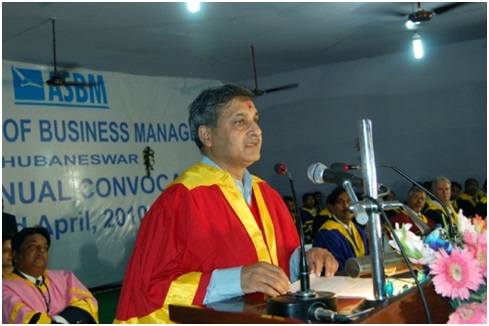
The 3rd convocationof Asian School of Business Management, Bhubaneswar
Address by
PROF. D P AGRAWAL
Chairman, Union Public service commission, New Delhi
April: 03, 2010
Chairman, Union Public service commission, New Delhi
April: 03, 2010
The Chairman Board of Governors, Mr. Rakesh Kalra, Managing Director, Mahindra Navistar Automotive Ltd., Founder and Group Director of the Asian School of Business Management, Professor Biswajeet Pattanayak, members of the Trust, Board of Governors and Academic Advisory Council, faculty Members, graduating students and their proud parents, distinguished guests, ladies and gentlemen.
I am delighted as well as privileged to be amongst you all on this joyous occasion of the 3rd convocation of this prestigious institution. I am especially happy celebrating this occasion with the younger generation who are the future of our country. I will cherish the memory of your gracious welcome. I thank Prof Pattanayak for inviting me to be here today.
I am extremely happy to learn about the excellent achievements of this Institution and the laurels it has received in championing the cause of world class management education at all its campuses in a very short span of time. I understand that ASBM stands for enhanced global education through opportunities for the exchange of visits, collaborative teaching and research. It is gratifying to know that the Institute also has innovated through ASBM Finishing School and Centers of Excellence such as in Logistics & Supply Chain Management, Entrepreneurship Development Cell, Centre for Distance Education, Industry Institute Partnership Cell, Centre for Social Responsibility etc. I congratulate the Director & his team members for emphasizing on the unique value proposition attached to the process of management learning focused at ASBM.
Dear Graduates, I congratulate you on your proud achievements. But more than you I congratulate your parents in reposing faith in your capabilities. They had a very different set of expectations for you. They wanted you to prosper and to take your rightful place in the growth of India and at times they made sacrifices so that you could live a better life. So I would ask you to stand and acknowledge your parents in gratitude for all that they have done for you!
I am delighted as well as privileged to be amongst you all on this joyous occasion of the 3rd convocation of this prestigious institution. I am especially happy celebrating this occasion with the younger generation who are the future of our country. I will cherish the memory of your gracious welcome. I thank Prof Pattanayak for inviting me to be here today.
I am extremely happy to learn about the excellent achievements of this Institution and the laurels it has received in championing the cause of world class management education at all its campuses in a very short span of time. I understand that ASBM stands for enhanced global education through opportunities for the exchange of visits, collaborative teaching and research. It is gratifying to know that the Institute also has innovated through ASBM Finishing School and Centers of Excellence such as in Logistics & Supply Chain Management, Entrepreneurship Development Cell, Centre for Distance Education, Industry Institute Partnership Cell, Centre for Social Responsibility etc. I congratulate the Director & his team members for emphasizing on the unique value proposition attached to the process of management learning focused at ASBM.
Dear Graduates, I congratulate you on your proud achievements. But more than you I congratulate your parents in reposing faith in your capabilities. They had a very different set of expectations for you. They wanted you to prosper and to take your rightful place in the growth of India and at times they made sacrifices so that you could live a better life. So I would ask you to stand and acknowledge your parents in gratitude for all that they have done for you!
You represent a new generation of business leaders. Commit now to embracing social responsibility, accountability, fairness, and honesty as the core values that guide your work experience. Let us understand that these values must be at the heart of each of you because the survival of the many is unquestionably more important than the personal wealth of a few.
We all know the views of Mahatma Ghandiji on it and I quote “what belongs to me is the right to an honourable livelihood, no better than that enjoyed by millions of others. The rest of my wealth belongs to the community and must be used for the welfare of the community.” Pt. Nehru in his famous speech “A Tryst with Destiny” put the Goal for all of us as a nation “That future is not one of ease or resting but of incessant striving so that we may fulfill the pledges we have so often taken and the one we shall take today. The service of India means the service of the millions who suffer. It means the ending of poverty and ignorance and disease and inequality of opportunity. The ambition of the greatest man of our generation Mahatma Gandhi has been to wipe every tear from every eye. That may be beyond us, but as long as there are tears and suffering, so long our work will not be over.”
We all know the views of Mahatma Ghandiji on it and I quote “what belongs to me is the right to an honourable livelihood, no better than that enjoyed by millions of others. The rest of my wealth belongs to the community and must be used for the welfare of the community.” Pt. Nehru in his famous speech “A Tryst with Destiny” put the Goal for all of us as a nation “That future is not one of ease or resting but of incessant striving so that we may fulfill the pledges we have so often taken and the one we shall take today. The service of India means the service of the millions who suffer. It means the ending of poverty and ignorance and disease and inequality of opportunity. The ambition of the greatest man of our generation Mahatma Gandhi has been to wipe every tear from every eye. That may be beyond us, but as long as there are tears and suffering, so long our work will not be over.”
Vast population of the country lives in poor conditions. In cities 60 percent population live in slums. The large population who lives in villages has poor living conditions in any way. Existence of slums is a reality not only in India but many other developing countries. Migration of work force to cities has created them. Many of them have little or no access to basic urban services. Let us not forget that slum dwellers provide vital services to the city at a much lower cost.
While these pose a great challenge to governments, they offer enormous opportunities to innovative enterprises to do business simultaneously. Slum dwellers’ basic needs and minimum demands when put together amounts to a very large market for the marketers to exploit. It challenges companies to produce newer products and offering which they can buy and use. While technology intervention have brought qualitative change to the life of well to do people, its benefits have not reached to these groups of people. The main reason for this has been poor education, no familiarity with technology, its cost and operational difficulties.
Enterprises can look to provide services at the local level which connect to the city level and include: roads and pavements, water supplies to individual households; underground sewer links for individual households; street lighting; landscaping and solid waste management; toilet blocks to individual houses; and storm water drainage arrangements.
While these pose a great challenge to governments, they offer enormous opportunities to innovative enterprises to do business simultaneously. Slum dwellers’ basic needs and minimum demands when put together amounts to a very large market for the marketers to exploit. It challenges companies to produce newer products and offering which they can buy and use. While technology intervention have brought qualitative change to the life of well to do people, its benefits have not reached to these groups of people. The main reason for this has been poor education, no familiarity with technology, its cost and operational difficulties.
Enterprises can look to provide services at the local level which connect to the city level and include: roads and pavements, water supplies to individual households; underground sewer links for individual households; street lighting; landscaping and solid waste management; toilet blocks to individual houses; and storm water drainage arrangements.
The management of slums has been very complex process as it calls to creating Literacy, Income generation capabilities, Provision of affordable housing, Sanitation, Water supply, Road network and facilities for Health. Social Activities are encouraged to prevent crime, violence and immorality. The management models must realize that slum dweller always look for the government helps, debt, relief etc. and wait for them, this type of mentality and government plans make them paralyzed instead of self reliant. There are Government plans to improve their poor condition.
It has also been observed in SEWA’s activities in the slums that inputs in such Programme as health have a limited impact, if given without adequate basic amenities in the house and infrastructure within the slum locality. The development of infrastructure and the provision of basic amenities have a very decisive influence not only on health, education and income, but also the social life of the urban poor and their empowerment. For this, vast investments are needed. New financial models having slum dwellers as stake holders need to be developed.
To my young friends I would like to say that, an MBA Programme cannot make a manager straightaway. It just teaches you the basic business skills. You always start from the bottom and work your way up through continuously proving yourself. It always takes time. I also do not know if MBA Programmes taught the secrets of overcoming bad economies but this is what people are expecting. You need a managerial mindset in order to compete and prove yourself. I am also aware that some students come to the MBA for the prestige of it thinking that an MBA will push them high into the corporate pyramid. Others come to acquire new skills that enable them to compete into the competitive business market. Very few come to acquire a new mindset and understand the nuances of the business. MBA Programme designers should understand their clients and accommodate the Programme based on the future expectations of the market. Generic MBA Programme is losing value as more focused and specialized Programme are emerging. The Programmes must continuously upgrade and innovate curriculum which offer wider choice of electives, Real technical courses and enable the graduates to Networking with the business world. When I was at Indian Institute of Information Technology and Management at Gwalior, I had an opportunity to develop IT integrated management Programme for the business world of today. This has resulted in researches by faculty and students in areas such as ERP, CRM, KM, DSS, data management and data mining and supply chain. Even today, I consider them as futuristic.
It has also been observed in SEWA’s activities in the slums that inputs in such Programme as health have a limited impact, if given without adequate basic amenities in the house and infrastructure within the slum locality. The development of infrastructure and the provision of basic amenities have a very decisive influence not only on health, education and income, but also the social life of the urban poor and their empowerment. For this, vast investments are needed. New financial models having slum dwellers as stake holders need to be developed.
To my young friends I would like to say that, an MBA Programme cannot make a manager straightaway. It just teaches you the basic business skills. You always start from the bottom and work your way up through continuously proving yourself. It always takes time. I also do not know if MBA Programmes taught the secrets of overcoming bad economies but this is what people are expecting. You need a managerial mindset in order to compete and prove yourself. I am also aware that some students come to the MBA for the prestige of it thinking that an MBA will push them high into the corporate pyramid. Others come to acquire new skills that enable them to compete into the competitive business market. Very few come to acquire a new mindset and understand the nuances of the business. MBA Programme designers should understand their clients and accommodate the Programme based on the future expectations of the market. Generic MBA Programme is losing value as more focused and specialized Programme are emerging. The Programmes must continuously upgrade and innovate curriculum which offer wider choice of electives, Real technical courses and enable the graduates to Networking with the business world. When I was at Indian Institute of Information Technology and Management at Gwalior, I had an opportunity to develop IT integrated management Programme for the business world of today. This has resulted in researches by faculty and students in areas such as ERP, CRM, KM, DSS, data management and data mining and supply chain. Even today, I consider them as futuristic.
Delivering Hiren Mukharjee memorial Lecture this year to both the houses of Indian parliament, Dr. Yunus, noble laureate, high lighted the urgent need for removal of poverty around the world. His experiment of micro financing through “Grammeen Bank” in Bangladesh continues to lift millions out of poverty and boasts a 98 percent rate of loan repayment. That’s a rate of return that any bank couldn’t begin to match right now. He further articulated that through corporate social responsibility — donating a portion of your business profits to the poor, the poverty could be alleviated.
ASBM Convocation Address
He strongly advocated the need of establishing social business. The concept of the social business is part non-profit corporation, part service organization, and 100 percent self-sustaining. It begins with an initial philanthropic investment that will be repaid but without interest. Once the start-up expenses are covered, the business supplies the community with the high-need manufactured goods or service, at or near cost.
ASBM Convocation Address
He strongly advocated the need of establishing social business. The concept of the social business is part non-profit corporation, part service organization, and 100 percent self-sustaining. It begins with an initial philanthropic investment that will be repaid but without interest. Once the start-up expenses are covered, the business supplies the community with the high-need manufactured goods or service, at or near cost.
In a globalized world we value differences – in appearance, culture, religion, gender, and thought. In opinion, the diversity in thought, culture, and religion, is equally critical to our survival. The social psychologists emphasize that we like people like ourselves. That’s only natural. Our appreciation and respect to diversity must mean that we commit ourselves to fairness, equity, and respect for people who are different from us, not just because it’s the right thing to do but also because ultimately, it’s in our own best interests. Therefore assemble a team that is diverse in age, gender, culture, and even political persuasion. Always intend to hire the best talent available, regardless of sex, age, religion, race, or party affiliation.
You are fortunate to be part of a developed academic system, which stands for humanism, for tolerance, for reason, for progress, for the adventure of ideas and for the search for truth. You must also recognise the growing aspirations of people to lead quality life. We must understand and apprise our people the right meaning of quality of life. Should it be the carbon copy of the West bordering on higher rate of consumption or should it draw from the ethos of this great nation ? Human well-being remains the main responsibility of all citizens.
We are a country with a very large telephone/internet connectivity. Herein lies a tremendous opportunity not yet realized, for India to help more of its rural poor become literate, global citizens and entrepreneurs. This permits you to do business in much wider space. IT could be used to serve the needs of customers anywhere in the world, give artisans, farmers, and weavers access to the training to develop needed skills and entry to the global marketplace, or put the Internet at the disposal of a teacher in a one-room schoolhouse or a doctor in a health clinic in rural India and see what change you can create.
Technology applications such as these may help to address some of the most significant problems that different nations face. This technology revolution will play out differently for countries around the globe depending on its preparedness. The Government of India is focusing on the gigantic task of creating the right kind of manpower needed to take differential advantage of technology. The states can not remain in isolation on this issue; instead they too need to be committed towards it.Universities in India are faced with the dual demands of delivering quality education and of surviving extinction as the challenge of global competition mounts. Emphasis is now on developing multi skilled graduates endowed with holistic knowledge consisting of core professional knowledge, soft skills and business skills. I wish to emphasise on the need for a new approach to curriculum delivery making it flexible, student centric (enables the innate quality of a student to emerge) and creating life long learners rather than crammers.Shri Aurobindo had laid a number of principles on teaching and learning. I mention two of them here. The first principle is that nothing can be taught; the teacher is a helper and a guide; his business is to suggest not impose; he does not impart knowledge but shows the student how to acquire it for himself. The second principle is that education cannot be forced on an unwilling mind. Indeed the mind has to be consulted in its own growth. The same was also emphasized by Gandhiji. Sri Aurobindo also identified the important attributes that a student should acquire as the capacity of attention, concentration and faithfulness of memory. Some of these thoughts are being pursued today by many global universities.I wish to share with you my thoughts on a very crucial issue of quality Public services as a vehicle for development and opportunities thereof. The fruits of growth need to percolate to the needy. Many developed countries during the similar phase in their developmental process ensured that government provides the essential and social services to its citizens. The state is clearly the key actor in the provision of public services. Some are public goods such as law and order, which benefit all people, basic education, preventive health, maintenance of certain common facilities, drinking water, PDS, transport, pollution control etc. The responsibility for their quantity, quality and productivity rests with a wide range of government departments and agencies, both at the central and state levels. It must be understood that people manning the public services get enormous opportunity to show case their latent and innovative attitude for solving waxing problems of public at large. It not only gives them satisfaction but also the name in society. It has been noticed over the years that a very large number of young men and women attempts to be the part of this work force.
The government’s role is changing in significant ways as newer models on partnership between government, NGOs and private providers are emerging. These partnerships shall off load many functions of government in the production and delivery of public services. Such partnerships could be in terms of technology, finance or innovative practices that enhance performance of service providers. It will have to assemble staff with the skills, experience, and incentives to regulate and supervise the new private service providers.
The public services in this country offer a variety of positions and job opportunities for innovative, honest and hard working individuals. In fact the government is still the largest employer. The sixth pay commission has offered a very lucrative compensation package. Coupled with the fact that you have an opportunity to impact the life of millions, I urge the graduating students to look for a career in public services.
As government move towards an indirect management or oversight role, it will call for a significant reorientation in terms of competence, behavior, and attitudes of its staff.
Keeping this in view, Universities may plan education Programme and undertake research on issues related to public services. Some indicative areas for research are:
1. Economic development and regeneration (urban, rural & regional)
2. Evaluation and performance management of public services
3. Governance of the public and voluntary sectors and governance across sectors
4. Global environmental problems and solutions
5. Health services policy and organisation
6. Education policy and management
7. Voluntary/third sector organisation and management
8. Changing public policy and organisational change and public services
I wish that many of you become entrepreneurs. Go out and create businesses and jobs that lift thousands of your countrymen and women out of poverty. Be the agent of change in people’s lives. I don’t believe there is any rose garden in a competitive world and one must do the best.
The great institutions of the world are known by the commitments shown by their alumni. I suggest that you leave this institute with a thought that “I will try my best to contribute to the growth of this institute because I did not just get an excellent studies experience only but I lived in a very liberal environment that shaped my vision of the world as well”.
Technology applications such as these may help to address some of the most significant problems that different nations face. This technology revolution will play out differently for countries around the globe depending on its preparedness. The Government of India is focusing on the gigantic task of creating the right kind of manpower needed to take differential advantage of technology. The states can not remain in isolation on this issue; instead they too need to be committed towards it.Universities in India are faced with the dual demands of delivering quality education and of surviving extinction as the challenge of global competition mounts. Emphasis is now on developing multi skilled graduates endowed with holistic knowledge consisting of core professional knowledge, soft skills and business skills. I wish to emphasise on the need for a new approach to curriculum delivery making it flexible, student centric (enables the innate quality of a student to emerge) and creating life long learners rather than crammers.Shri Aurobindo had laid a number of principles on teaching and learning. I mention two of them here. The first principle is that nothing can be taught; the teacher is a helper and a guide; his business is to suggest not impose; he does not impart knowledge but shows the student how to acquire it for himself. The second principle is that education cannot be forced on an unwilling mind. Indeed the mind has to be consulted in its own growth. The same was also emphasized by Gandhiji. Sri Aurobindo also identified the important attributes that a student should acquire as the capacity of attention, concentration and faithfulness of memory. Some of these thoughts are being pursued today by many global universities.I wish to share with you my thoughts on a very crucial issue of quality Public services as a vehicle for development and opportunities thereof. The fruits of growth need to percolate to the needy. Many developed countries during the similar phase in their developmental process ensured that government provides the essential and social services to its citizens. The state is clearly the key actor in the provision of public services. Some are public goods such as law and order, which benefit all people, basic education, preventive health, maintenance of certain common facilities, drinking water, PDS, transport, pollution control etc. The responsibility for their quantity, quality and productivity rests with a wide range of government departments and agencies, both at the central and state levels. It must be understood that people manning the public services get enormous opportunity to show case their latent and innovative attitude for solving waxing problems of public at large. It not only gives them satisfaction but also the name in society. It has been noticed over the years that a very large number of young men and women attempts to be the part of this work force.
The government’s role is changing in significant ways as newer models on partnership between government, NGOs and private providers are emerging. These partnerships shall off load many functions of government in the production and delivery of public services. Such partnerships could be in terms of technology, finance or innovative practices that enhance performance of service providers. It will have to assemble staff with the skills, experience, and incentives to regulate and supervise the new private service providers.
The public services in this country offer a variety of positions and job opportunities for innovative, honest and hard working individuals. In fact the government is still the largest employer. The sixth pay commission has offered a very lucrative compensation package. Coupled with the fact that you have an opportunity to impact the life of millions, I urge the graduating students to look for a career in public services.
As government move towards an indirect management or oversight role, it will call for a significant reorientation in terms of competence, behavior, and attitudes of its staff.
Keeping this in view, Universities may plan education Programme and undertake research on issues related to public services. Some indicative areas for research are:
1. Economic development and regeneration (urban, rural & regional)
2. Evaluation and performance management of public services
3. Governance of the public and voluntary sectors and governance across sectors
4. Global environmental problems and solutions
5. Health services policy and organisation
6. Education policy and management
7. Voluntary/third sector organisation and management
8. Changing public policy and organisational change and public services
I wish that many of you become entrepreneurs. Go out and create businesses and jobs that lift thousands of your countrymen and women out of poverty. Be the agent of change in people’s lives. I don’t believe there is any rose garden in a competitive world and one must do the best.
The great institutions of the world are known by the commitments shown by their alumni. I suggest that you leave this institute with a thought that “I will try my best to contribute to the growth of this institute because I did not just get an excellent studies experience only but I lived in a very liberal environment that shaped my vision of the world as well”.
My young friends, you all are moving into an environment where the competition will not be limited to the fellow citizen but from all over the globe. You need to be creative, forward looking and flexible. Understand your ‘self’. In you lives the “Brahm – the creater” so said Vivekanand. This understanding shall lead you on the path of truth, compassion and glory.
Jai Hind.