

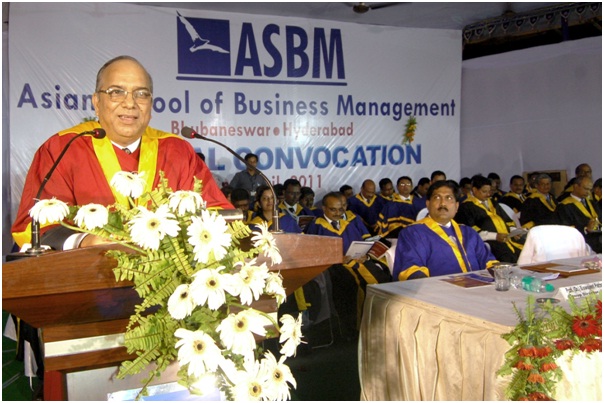
ANNUAL CONVOCATION-2011 Chief Guest’s Address
ANNUAL CONVOCATION
Chief Guest’s Address
by
Justice Mr. Ananga Kumar Patnaik
Judge, Supreme Court of India
2ndApril, 2011
Mr. Rakesh Kalra, Chairman of the Board of Governors, Prof. Biswajeet Pattanayak, the Group Director, Members of the teaching and non-teaching staff and my dear students of the Asian School of Business Management, ladies and gentlemen. A very good evening to all of you.
I have seen my father managing business since my childhood. In the 1940s, my father late Gopal Chandra Patnaik left his job in the Board of Revenue, Orissa, and started the business of fabricating bus and truck bodies. He managed the dealership of Messey Ferguson tractors, Fiat cars, Mahindra jeeps and Dodge commercial vehicles such as vans, trucks and buses. He owned retail outlets of the Petroleum giant Burmah Shell Company. He set up a small-scale pharmaceutical manufacturing unit and also a Reinforced Cement Concrete Pipe factory. He managed business by the trial and error method using his entrepreneurial skills and was not a management graduate or diploma.
After I finished school and joined college in 1966, I studied Public Administration as one of the eight papers of Political Science in Kirori Mal College, Delhi University and Public Administration dealt with Government and Public Sector administration and did not include Business Management. It was only in the late 1960s that I saw for the first time an Institute of Business Management established in the premises of the Delhi School of Economics. Later on, I got to hear of the Institutes of Management in Calcutta and Ahmedabad and other places. Over the last fifty years, therefore, there has been shift from entrepreneurship to professional management of business; a transition from the art of doing business learnt through experience to Business Management as knowledge acquired by study in an Institute.
With the Government liberalising its policy and privatising many of the erstwhile governmental functions, the demand for Business Management graduates and diplomas has grown in new areas such as Banking, Insurance and Financial Sectors, Education, Hospitals and even in sectors which were hitherto unorganised such as retailing and housing. Business Management Institutes have consequently been established all over the country to cater to this increasing demand of our economy. I find from the Information Bulletin of the Asian School of Business Management that this School confers not only Post Graduate Diploma in Management but also in International Business, Banking, Insurance & Financial Services, Retail Management and Logistics & Supply Chain Management to cater to this growing demand of the economy.
The goal of Business Management has been to earn maximum profits through production and sale of goods or services. Of late, some business houses have started thinking of Corporate Social Responsibility and management studies in different Institutes of Business Management therefore now include Corporate Social Responsibility as one of the subjects of study. Corporate managers are now-a-days instructed to undertake various social welfare activities such as education of children, health of the community and conservation of environment as part of their public relations exercise. The large turn-out of management graduates and diplomas from different Institutes of Business Management have no doubt contributed to the economic progress of our country. Without the management institutes producing knowledgeable and efficient managers, our country perhaps would not have attained the economic growth at a galloping rate which is one of the highest in the world and second only to China. The Corporate Houses in India in recent years have been major contributors to governmental revenues enabling the Government to invest the surplus revenue in different social sectors of the economy and in social welfare projects.
The developments during the last decade in our country, however, show that in some areas Management by the Corporate Houses is deficient on account of which there are serious road blocks to sustainable development in our country. We have a written Constitution and Part-III of the Constitution confers fundamental rights on various persons and citizens. Besides fundamental rights, there are some constitutional rights conferred by the Constitution on some of the weaker sections of our society such as the Scheduled Castes, Scheduled Tribes and other backward classes of our society. Even the power of Parliament and the State Legislatures to make laws is subject to such fundamental rights and constitutional rights. The Supreme Court has held time and again that rule of law is a basic feature of the Constitution and therefore, laws and rules have to be obeyed by all concerned including the Governments. Any breach of the laws and the rules will entitle a person to move the Court. Infraction of the law and the rules may also attract penal consequences. No business house, however, mighty and wealthy it may be, can therefore afford to violate a fundamental right, constitutional right or any other law or rule and if it does, it does at the risk of intervention or punishment by Courts. Experiences of the last decade have shown that business houses have recklessly tried to set up projects or carry on business in breach of the fundamental rights, constitutional rights, the laws and the rules and this has resulted in litigations and intervention by Courts resulting in delays in execution of projects and in some cases also closure of the business. The Newspapers are full of cases of some individuals from the business community indulging in corruption in clear violation of the anti-corruption law and in large scale tax evasion. I have known of a case where a Dam has been constructed ready to generate electrical energy but it could not generate electricity because of the orders passed by the Courts to protect the fundamental right to life of persons living in areas likely to be submerged. Had the management of the concerned corporation taken early steps to rehabilitate such persons, early generation of electricity for the benefit of the consumers would have been possible. I have also known of a case where the High Court had to direct closure of an ongoing industry because the industry had polluted the environment beyond the permissible limit and had not taken the precautionary measures envisaged by law. Recently, our Prime Minister Dr. Manmohan Singh addressing the students of the Indian Institute of Management, Ahmedabad at the 46th Convocation of the business school, said: “The pace of reform in India will depend on how far our policies meet the test of democratic consensus and take into account vulnerabilities of different sections…Companies undertaking greenfield projects cannot see their factories and units as oasis, cut off from the needs and interests of the community around them.” It is, therefore, time that Institutes of Business Management also taught their students the constitutional and legal limitations within which business can be carried on by any individual or firm or corporation.
I now congratulate the students who have been conferred with Post Graduate Diploma in Business Management at this Convocation as well as those who have earned their Medals for their outstanding performance. Please, however, remember that the diploma obtained by you is only an entry pass into a career in Business Management and it is not a guarantee for success throughout your long career. Similarly, those who have been conferred with the Medals may start with a better job and a bigger pay- packet than others but the medals cannot be of much help in climbing up the career ladder. The upward rise in your career will depend upon how best you apply the knowledge you have acquired in this business school, how disciplined you are in your work, character and health and also how much up-to-date you are with your knowledge and information regarding your job. Entry into a professional career is like a beginning in a marathon race in which one who starts first may not necessarily end first, but the one who is steady and consistent like the tortoise may in the long race leave behind the rabbit who gets tired after a few jumps and retires from the race midway.
With sound professional knowledge, hard work and disciplined conduct, I have no doubt that you will earn a decent income in a corporate house in India or abroad. Earlier, there was a craze amongst the management graduates and diplomas to take a lucrative job in the U.S. This craze is no longer there. The Hindustan Times dated 8th March, 2011 reports that 90% of the Indian students in the U.S. are keen to return to India to pursue career in their home country. This change is perhaps because of the growing size of the Indian market which has attracted even the U.S. President Obama to our country. This is the reason why your parents financed your study of business management. I hope, you will live up to the expectations of your parents and discharge your obligations towards them during their old age. You also have your commitments to your alma mater the Asian School of Business Management. In fact, alumni of different institutes who have done very well in life have been showing the magnanimity of contributing their might to growth of their alma mater. The Asian School of Business Management may not expect any financial contribution from you but it has right to expect that you will, whenever convenient, come back to the institute and share your knowledge and experience with the students and the staff of the institute. With these few words of guidance, I wish the students passing out from this Institute a very successful and happy future.
I thank the Asian School of Business Management for having given me this opportunity to address the students and the staff of the Institute and giving this opportunity to my wife and me to visit your wonderful campus.